From Burnout to Balance: What Chronic Stress Is Doing to Your Body
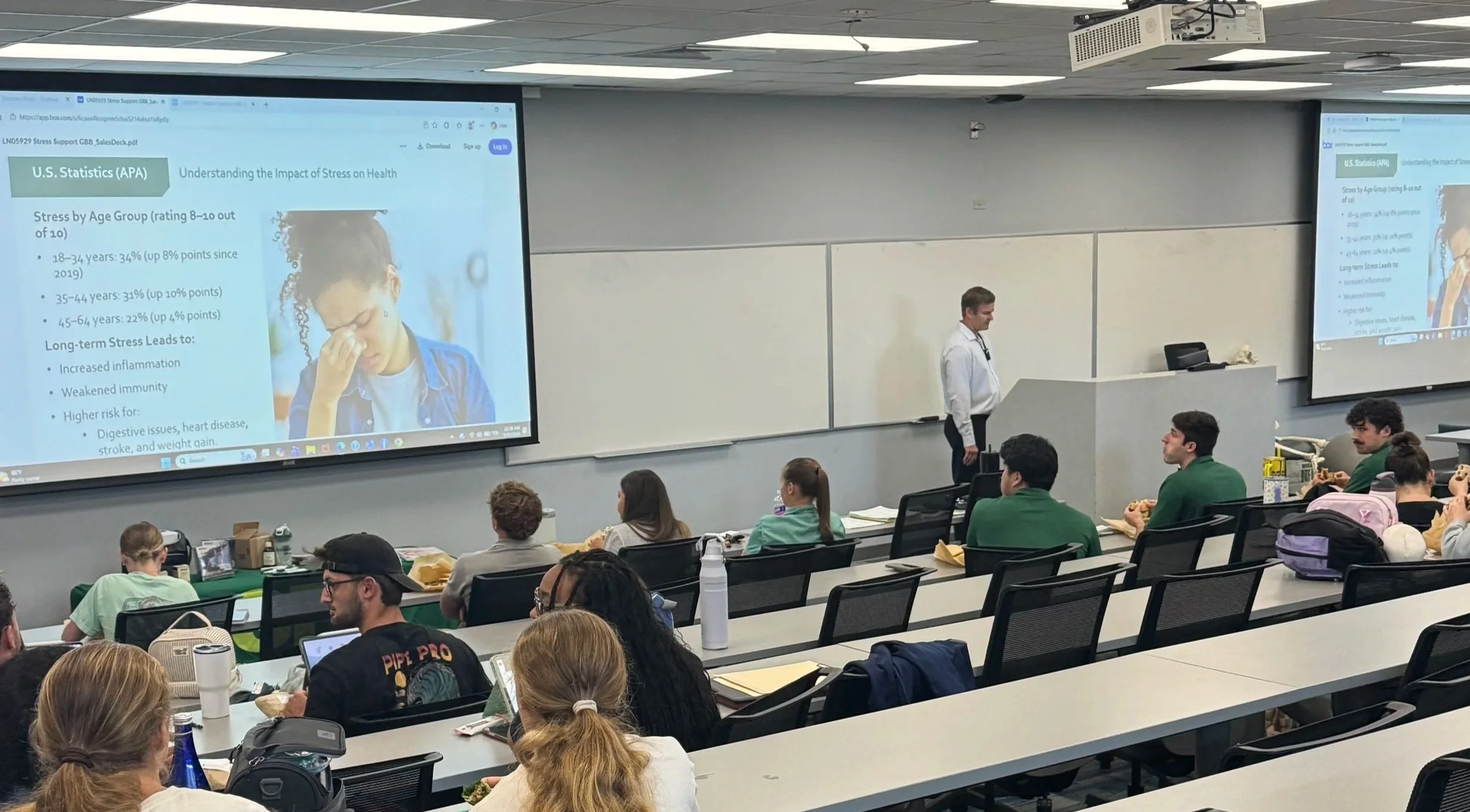
Recently, I had the opportunity to return to Logan University to speak with a group of chiropractic students about something I am seeing more and more frequently in practice: young, otherwise healthy people who are exhausted.
They are tired when they wake up. They rely on caffeine or energy drinks to get through the day. They crash in the afternoon, struggle to shut their brains off at night, don't sleep well—and then wake up and do it all over again.
I called the presentation “From Burnout to Balance.”
There was something particularly meaningful about giving this presentation at Logan. Almost exactly 30 years ago, I walked into that same classroom as an incoming chiropractic student. I certainly didn't know then what the next three decades would look like, but I knew I wanted to help people. Thirty years later, that is still why I do what I do.
What I didn't expect was how much younger the patients struggling with chronic stress and fatigue would become.
The Body Is Built to Handle Stress—But It Needs to Recover
Our stress response is not the enemy. We need it.
When the body perceives a stressor, the sympathetic nervous system activates. Epinephrine, norepinephrine, and cortisol help increase heart rate, blood pressure, alertness, and available energy. This is the classic “fight-or-flight” response, and in the right situation, it is exactly what we want the body to do.
The problem is that many of us rarely give that system an opportunity to shut back down.
Work. School. Family. Poor sleep. Financial stress. Skipped meals. Another deadline. Another cup of coffee.
Eventually, the body starts showing us that it isn't recovering well. Fatigue, irritability, difficulty concentrating, sleep disturbances, and that feeling of being simultaneously exhausted and unable to relax can all enter the picture.
I call it being “wired but tired.”
And one of the biggest contributors I am seeing in younger patients is something that has become incredibly normalized: energy drinks.
You Can't Manufacture Energy Forever
I gave the students a hard time about their energy drinks during the presentation—and I do the same thing with my patients.
Caffeine can increase alertness. What it cannot do is replace sleep, adequate nutrition, or recovery.
I describe an energy drink as a chemical alarm clock. You're tired, but instead of addressing why you're tired, you're telling the body, I need you to keep going.
So you get the temporary boost.
Then you crash.
You reach for another one.
Eventually nighttime comes and you're exhausted—but now you can't sleep. The next morning you wake up tired, reach for caffeine again, and the cycle repeats.
This is where understanding cortisol becomes important.
Cortisol naturally follows a diurnal rhythm. It should be higher around the time you wake up and gradually decline throughout the day as your body prepares for sleep. Cortisol also plays an important role in maintaining blood glucose and mobilizing energy during periods of stress.
When the stress response is continually activated, the effects don't stay isolated to whether you feel “stressed.” Sleep, blood sugar regulation, digestion, cardiovascular function, mood, and energy can all be affected.
That's why when a patient tells me, “I'm tired all the time,” my first question isn't simply, What can I give you for energy?
I want to know why you're tired.
Look at the Whole Patient
This is one of the most important things I wanted the students to understand.
Fatigue isn't a diagnosis.
I want to know what you're eating. How are you sleeping? How much caffeine are you consuming? What medications are you taking? What other symptoms are present? What kind of stress are you under? Are you getting the nutrients your body needs?
Nutrition is a major part of that conversation because we cannot continually ask the body to perform without giving it the building blocks it needs.
Start with the basics: adequate protein, complex carbohydrates, healthy fats, vitamins and minerals, hydration, and regular meals. At the same time, look at what may be working against you—excess sugar, caffeine, alcohol, poor sleep, and constantly asking your body to operate at full speed.
Depending on the patient, I may also use symptom surveys, physical assessments, or laboratory testing to get a better picture of what is happening.
I believe strongly in testing and retesting whenever possible.
If we make an intervention, I don't only want a patient to tell me they think they feel better. I want to be able to look back and see what has actually changed.
Nutritional Support Isn't One-Size-Fits-All
I also spent part of the Lunch & Learn discussing some of the Standard Process and MediHerb products I use to provide nutritional support for patients dealing with stress and fatigue.
This is another area where individualized care matters.
The patient who is exhausted and struggling to get through the day isn't necessarily the same patient who is exhausted but can't sit still, can't shut their mind off, and can't sleep.
Those patients may require very different approaches.
This is also why I don't recommend walking into a store, grabbing a bottle labeled “stress” or “adrenal support,” and assuming it is automatically what your body needs. The goal isn't to find another substance that allows you to push yourself harder.
The goal is to understand what your body needs and support it appropriately while addressing the habits and stressors that got you there in the first place.
Finding Your Way Back to Balance
After nearly three decades in practice, one thing has become very clear to me: the body gives us warning signs.
We just aren't always very good at listening to them.
Being exhausted every day shouldn't automatically be accepted as the price of being busy. Neither should needing increasing amounts of caffeine just to feel normal.
There will always be stressful seasons. We can't eliminate every deadline, responsibility, or difficult circumstance from our lives.
But we can pay attention to how our bodies are responding.
We can improve what we eat. We can protect our sleep. We can move our bodies. We can evaluate what we're using to manufacture energy. And when something still doesn't feel right, we can dig deeper instead of simply covering up the symptom.
That was ultimately what I wanted those future doctors at Logan to understand.
Don't just ask how you can help someone keep pushing.
Find out why they're running on empty.
Yours in health,
Dr. Doug Meyer